Body markings have different naming derivatives in Africa: marks, cuttings, scarifications are a few of them. Whatever they are called, they are indigenous identification skin symbols called tribal marks. They are found significantly in Africa. It is an early invention that applied to the native people of Africa. They have withstood the test of time to the extent that they survive till today.
Tribal marks are a significant component of African culture. It is subsumed in the echelon of body adornment. They achieve the purpose of beautification among several other functions. In many African cultures, tribal marks are considered a form of beauty and exceptional body adornment. Other purposes include identification purpose, cultural/ethnic identity, and religious beliefs. All are woven into one. Under identification, tribal marks are unique to specific ethnic groups and can help distinguish one tribe from another. Reason being that the features of marks of one ethnic region is different from the other. By extension, placement of tribal marks can indicate a person’s social status. In some parts of Africa, especially where deities are accorded their pride of place, tribal marks can be associated with deities or ancestral spirits and may be believed to provide protection or special powers.
Tribal marks serve medicinal purposes to some extent. For example, in a situation whereby an abiku (a spirit child believed to be destined for an early death and to be reborn repeatedly) torments a family, they will engrave his face and body with certain marks and apply some medicinal charms as soon as the child dies. Thereafter, the child will be reborn by the same couple, but s/he will never be able to return (die) early again. S/he may even be born with the marks as a sign showing that the dead child has returned. This possibility is difficult to believe, but its attendant realities supersede its myth. Also, in the past, tribal marks and/or body markings were used for inoculation against diseases associated with little children. Smallpox (associated with Soponna, the deity of smallpox) is one of such deadly diseases.
Historically, the origin and practice of tribal marks is traced back to the 15th century in West Africa. According to Pa Adebayo Faleti (of blessed memory), Africa’s first newscaster, Africa’s first stage play director, and Nigeria’s first film editor and librarian with the first television station in Africa (WNTV), the practice began in Oyo during the reign of Alaafin Sango, the 3rd Alaafin of old Oyo Empire (15th – 16th century). It was a turbulent period when the Alaafin Sango himself led wars with his war commanders and warriors and virtually won all of them. Winning wars meant gaining more slaves as war booties. It was in his deft move to put a mark of recognition to distinguish the royalty that he introduced facial and body marks to the royal families. Princes, princesses and other members of the royal household were distinctly marked in a way that distinguishes them from the rest of the people. It was much later that various households in Oyo were permitted to create their own distinctive facial marks, and this was how it spread to other parts of Yoruba land. This account was given by Faleti on a television programme on culture and tribal marks.
In Oyo today, abaja mefa is the name given to the tribal marks on the royal family members. Abaja mefa is a combination of 3 lines lying on the cheeks in a horizontal format. Each of the 3 lines are broken into 2 to make it all 6. That is synonymous with the royal family in Oyo. Various households also have their own. Ile Aloodi in Oyo town has 3 lines standing upright on each cheek. It is called pele. If the 3 lines lie horizontal, they are called abaja meta. If the lines are similar but 4 in number, it is abaja merin. Ile Aluganku in Isale Oyo has something a bit complicated: 4 horizontal lines are drawn first – on top of the topmost stands 3 short lines on the frontal part of the cheek while 4 long ones are drawn close to the ear. It then carries in front a slant line almost across the nasal bridge. That singular line is called baamu. However, the marks are called Gombo atibaamu. With different styles and names, it is easy to identify every household with its marks. This is why tribal marks are credited as a form of identification, first and foremost.
There are other variations of tribal marks or body markings; these include tattoo and eje omo. Whichever way it is done on the body, it is often permanent unlike some of today’s tattoos that can be erased later. Eje Omo is a pain antidote often marked on people. When a child is born, he is given tribal marks and possibly circumcised while still a toddler. At that time, after the completion of the marks on the baby, interested individuals will step forward to get markings on their hands or legs, depending on the chosen part. The marks are symbolic and representational of a particular object or animal. It is believed that giving these marks to individuals will relieve the baby of all the pains of his/her markings. It works like magic. I have experienced it. I have tribal marks and traditional tattoos plus eje omo. My own eje omo are symbolic of a bird and a bow.
How does it feel having tribal marks in these modern times? I have got my own share of experiences. As a growing child in Lagos in the 70’s, I went through incessant mockery in the hands of my peers. Lagos is a metropolitan city devoid of tribal marks. Thus, anyone who wears them is simply an ara oke (someone from the hinterland). Growing up on Lagos Island was a hell of life that made me despise my tribal marks. I constantly blamed my parents for engraving marks on my cheeks. As a matter of fact, having marks made me lose my self-esteem. I felt inferior among my peers and wished I never came to Lagos.
However, 1986 ushered in a turning point in my perceptive sensibility to my tribal marks. I was on a performing contingent of the Lagos State Council for Arts and Culture in San Francisco. A young girl called Vondi, who was the daughter of one of the organisers of our performance expedition, fell in love with me. Her reason was hinged on her dream to be married to a typical African. To her, I fitted perfectly into that bill because my tribal marks easily gave me away as an original African boy. She appealed to her mother to persuade me to stay back. I went with her to her school where I was thoroughly engaged by her classmates who wanted to know more about tribal marks and Africa. In dishing out the little facts at my disposal, I strutted like a peacock whose pride was incomparable. For the first time in my life, I was so proud of my tribal marks. The rest, as they say, is history.
In conclusion, while the fashion is fading out, tribal marks still remain an irrevocable means of identification in the determination of pure Africanness. Tribal marks are completely different from modern day tattoos. Tribal marks are more meaningful than tattoos. They have both become part of our daily existence and shall remain so for a long time to come.
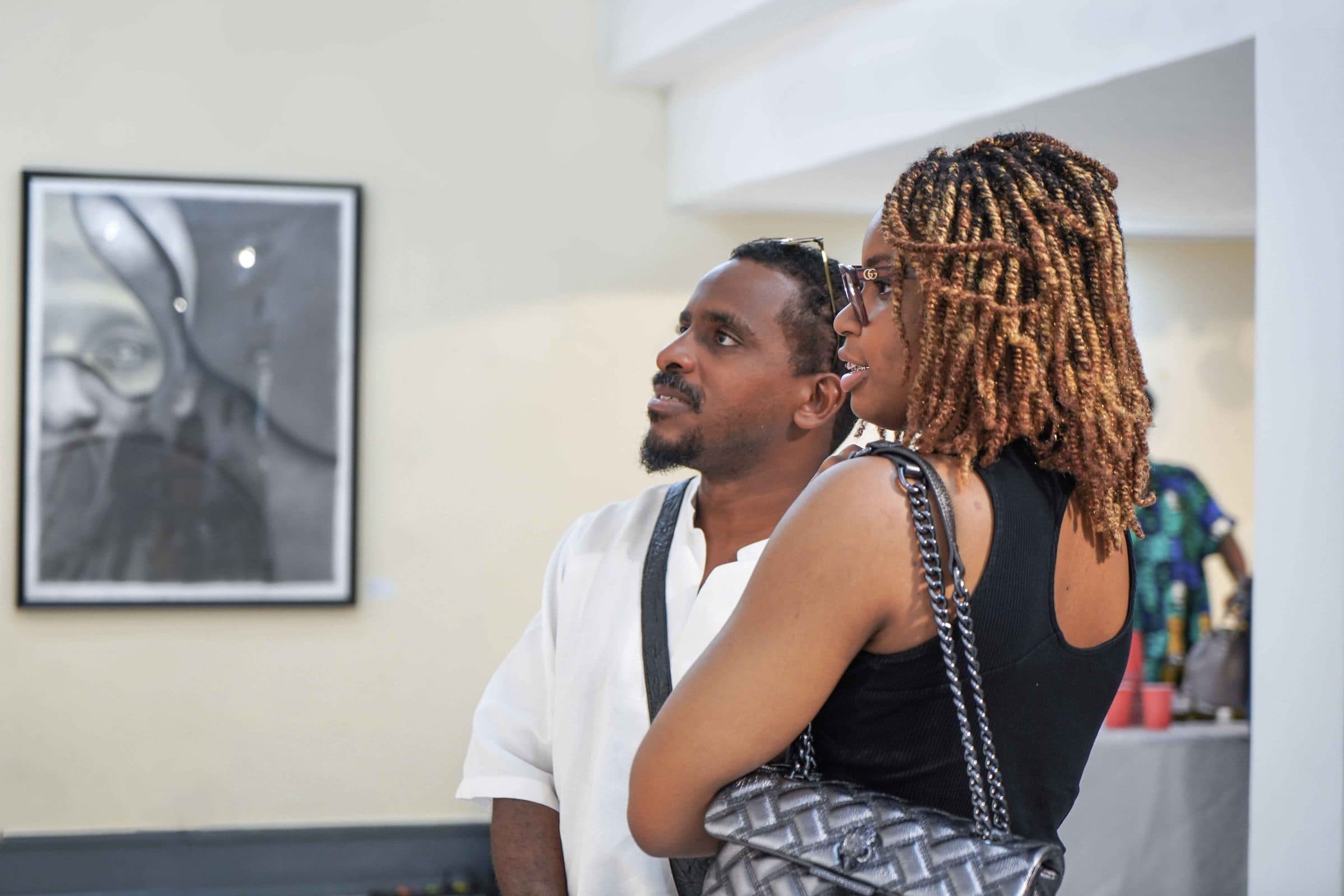
That Israel Fatola has chosen this path to translate these tribal marks into visual form for our aesthetic appreciation, is a way of reminding us of our socio-cultural heritage. This heritage has endured time and global trends.